A daughter who keeps canceling plans, a brother who skips family dinners, a mother who says she is “pagod lang”; the family sees these behavior changes but often dismiss them. As a result, many have been fighting their battles silently against anxiety disorder, while not seeking treatment when needed.
Around 359 million people lived with an anxiety disorder in 2021, but only about 1 in 4 received any anxiety treatment, per WHO data on anxiety disorders.
The Dinner Table Silence: What Filipino Families See But Rarely Name
Every Filipino family knows the version of the scene. The plate is half-eaten, the eyes do not lift, the answers come back in two words. We notice, but we eat. The talk shifts or we tell ourselves it is just a phase.
That silence is not coldness, it is ‘hiya’. It is the “ayaw kong makadagdag sa problema ng pamilya,” which sometimes comes from the belief that strong families do not air weakness out loud. Many of us were raised on that belief, and we pass it on without noticing. But the cost of that silence is steep.
While the family stays quiet, the family member with anxiety quietly concludes that no one sees them, and starts believing the weight is theirs alone to carry.
Read the related blog about Filipino family dynamics and mental health stigma
Why “Kaya Mo Yan” Doesn’t Help (and What Does Instead)
“Kaya mo yan” is offered with love. It is also one of the lines that pushes a Filipino with anxiety further into hiding.
The phrase frames anxiety as something the patient could fix by simply trying harder. Anxiety does not work that way. It is a nervous system stuck on high alert, a heart rate that climbs over ordinary moments, a mind that loops through worst-case scenarios at 2 a.m. What helps is a single sentence of acknowledgement, like “Hindi mo kailangan ipaliwanag, pero nandito kami.”
Acknowledgement does not require diagnosis, advice, or a fix. It only requires that the patient stops feeling invisible inside their own family. From there, treatment becomes a door they are willing to walk through.
Learn more about the overlap between depression and anxiety when the silence has stretched too long.

Signs to Watch For in Your Child, Sibling, or Parent
Anxiety symptoms rarely arrive noticeable. Most show up as small, persistent changes the family stops noticing because they are now the new normal.
Physical Signs
Some symptoms may appear, which most people assume are normal instances. Others might interpret them as potential heart conditions or insomnia, but these symptoms can also be due to unresolved anxiety.
Here are some of the physical symptoms of anxiety:
- lack of sleep followed by long naps
- heart rate that races during ordinary moments
- tension headaches
- muscle tension
- shortness of breath
- chest tightness mistaken for a heart problem
Behavioral Signs
Look for sudden withdrawal from gatherings, declining invitations they used to enjoy, or a long-standing hobby they have quietly dropped. Heavier reliance on alcohol, food, or substances, and rising stress around small decisions, are behavioral markers of an anxiety disorder.
Some Filipino patients also spend longer stretches on electronic devices late at night, which worsens sleep quality and amplifies anxious feelings the next day.
Read this related article on what to do during a panic or anxiety attack.
Emotional Signs
Notice irritability over small things, a flat tone in calls home, or a flood of “sorry” texts after ordinary disagreements. Anxious feelings often present as preemptive guilt; the patient apologizes for not replying, for being late, for existing in a heavy mood.
If your child shows these patterns, the signs your child has an anxiety disorder blog walks through age-specific markers worth tracking.
Anxiety Treatment Options in the Philippines (and Typical Costs)
Treatment for anxiety sometimes can be expensive, which can be one of the reasons why people tend to skip medical treatments. However, it is still important that patients understand the potential relief that these treatments can offer. Below are the common forms of treatment that psychologists and psychiatrists recommend to patients with anxiety.
Cognitive Behavioral Therapy (CBT)
CBT is the most researched form of talk therapy for generalized anxiety disorder, panic disorder, and social anxiety. The therapist guides the patient in identifying anxiety thoughts, testing their accuracy, and replacing them with more balanced reasoning, alongside breathing techniques and grounding practices the patient can use between sessions.
A typical course runs 12 to 20 weekly sessions.
Typical cost: PHP 1,500 to PHP 3,500 per session in the Philippines.
Read about cognitive behavioral therapy on NowServing.
Exposure Therapy and Other Talk Therapy
Many therapists layer exposure therapy on top of CBT when anxiety attaches to a specific situation, like driving, flying, public speaking, or crowded places. The patient and therapist plan small, graded exposures to the feared situation, paired with relaxation techniques like deep breathing.
Acceptance and commitment therapy, mindfulness-based therapy, and other forms of talk therapy may be added depending on the patient’s history.
Typical cost: PHP 1,500 to PHP 3,500 per session, depending on the practitioner.
Check out the psychotherapy service on NowServing for booking options.
Medication and Combined Treatment Plans
For panic disorder, severe chronic anxiety, or anxiety paired with depression, psychiatrists often prescribe medication alongside therapy. SSRIs are the most common; benzodiazepines are reserved for short-term use because of side effects and dependence risk.
A combined plan blends sessions, medication management, and lifestyle changes around sleep, physical activity, and stress levels.
Typical cost: PHP 1,500 to PHP 3,500 for psychiatric consultation, plus the cost of medication.
Browse psychiatrist doctor directory for medication treatment.
The Gift Card as an Opened Door, Not a Forced Conversation
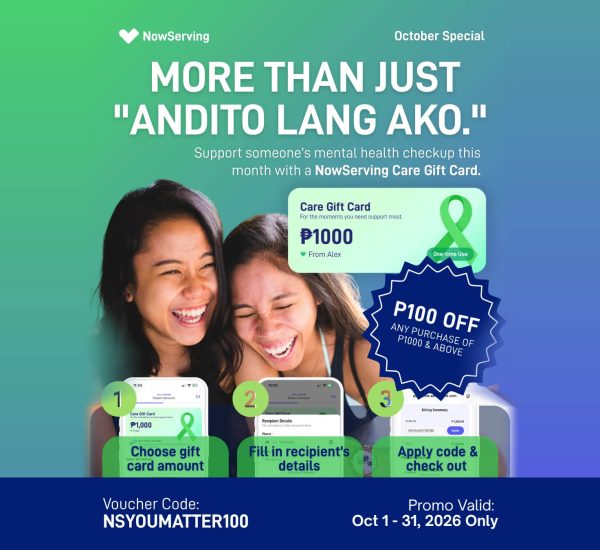
It’s no question that there’s an existing gap within Filipino families when it comes to speaking up about mental health. The ongoing stigma against mental health is also a contributing factor that leads to this communication gap. For families who have noticed the change but cannot find the opening line, the NowServing Care Gift Card was built precisely for the in-between space.
NowServing Care Gift Card is the newest service feature on the NowServing app where you can:
- send a custom amount gift card
- suggest a doctor to your recipient
- show your care without prying too much privacy
Show your care without forcing a conversation through sending a care gift card for mental health doctor consultation, allowing them to start their anxiety treatment. This gesture can be the first step to acknowledgement that your family member needs, allowing them to feel seen and accepted.
Visit the NowServing Gift Card page to know more about this feature.
Frequently Asked Questions About Anxiety Treatment and Usage of NowServing Care Gift Card
How much does anxiety treatment cost in the Philippines?
Anxiety treatment in the Philippines typically costs PHP 1,500 to PHP 5,000 per session, with monthly totals depending on therapy type, doctor specialty, and prescribed medication. Online sessions sit on the lower end of that range, while in-person hospital sessions sit on the higher end.
What is the best treatment for chronic anxiety?
The best treatment for chronic anxiety usually combines cognitive behavioral therapy, lifestyle changes, and, when needed, medication prescribed by a psychiatrist. Exposure therapy and mindful techniques are often added for panic disorder or specific phobias. You can find doctors who treat depression and anxiety on NowServing for combined-care guidance.
What if my family member refuses to talk about it?
The NowServing Care Gift Card was built for this situation. The recipient can keep the card until they feel ready, and there is no expiry pressuring them into a conversation. Consistent presence and lowered friction to care matter more than any prepared speech.
Can the gift card be used for psychiatric medication or assessment?
Yes. The card can fund a psychiatric consultation, a psychological assessment, or a follow-up doctor consultation with other mental health experts. However, it is only a one-time use gift card. In short, it can only be used for 1 mental health doctor consultation.
How do I know if it is anxiety and not just stress?
Stress usually has an identifiable trigger and lifts once the situation passes. Anxiety persists past the trigger, interferes with daily functioning, and brings physical symptoms like racing heart rate, poor sleep, and stomach issues. If the pattern lasts more than a few weeks, it is worth a consultation with a mental health doctor.
Conclusion
Anxiety treatment works, and most Filipino patients who stay in care report better sleep, fewer panic episodes, and a real improvement in quality of life. The wall is rarely the willingness, it is the cost of weekly sessions and the silence that surrounds the diagnosis at home.
Families do not need a perfect script to bridge that silence. Send a NowServing Care Gift Card today and quietly help your loved one start anxiety treatment.
Download the NowServing app to your device today!
This article is for general information only and is not a substitute for professional medical advice, diagnosis, or treatment. If symptoms are severe or getting worse, see a doctor or go to the nearest hospital.