Picture this: your friend finishes their last final, should feel relieved, and instead stares at the ceiling at 3 a.m. weeks later. These are scenes from academic burnout in young adults, the kind that builds.
Burnout is when the exhaustion does not lift even after the deadline passes. Big changes like a stretch of exams, a thesis defense, a board review, or an internship deadline can each trigger it, but the trigger is rarely where the story ends.
When “Pagod Na Ako” Means Something Heavier
Researchers describe academic burnout as a sustained pattern of emotional exhaustion, cynicism toward studies, and a loss of confidence in academic performance. When all three settle in at once, the impact of burnout drifts past grades into sleep, appetite, friendships, and a sense of self. The effects of burnout often outlast the semester, especially when academic pressure is sustained without breaks.
A WHO International College Student Project that surveyed 13,984 undergraduate students across eight countries found that around one in three young people reported a mental health disorder. Closer to home, a post-pandemic study of 200 Filipino college students at Xavier University-Ateneo de Cagayan found high academic burnout across the sample, with cynicism scoring highest and academic efficacy scoring lowest. The numbers, paired with the patterns visible in university students and high school students alike, point to a common and underdiagnosed problem.
Why They Choose Peers and Not Their Family
The fact that your friend opened up to you, and not to a parent, is not random. For many Filipino young adults, the family table is the last place a hard confession feels safe. In homes where academic success quietly doubles as proof of love, peer pressure from siblings and the silent ranking of report cards can close the door before a young person finishes their first sentence.
You also sit inside the same workload. The same syllabus, the same group projects, and the same impossible deadlines run through your schedule too, which means your friend does not have to translate the experience for you. That kind of shared ground is what makes peer support networks land where parental advice often cannot.
Read how you can help other mental health patients with this blog.
What Academic Burnout Looks Like?
You probably noticed the small shifts first, the kind that surface across ordinary school days. The warning signs cluster in three places and rarely show up alone, but a few of them together over weeks point to a pattern worth taking seriously.
Emotional Signs
Feelings of anxiety before a routine quiz, irritability over small things, and a flat tone in conversations are emotional markers worth tracking. A friend who once spoke about academic success with energy may now talk about school in clipped phrases, or stop bringing it up entirely. The shift can look like maturity from outside the friendship, which is part of why it hides so well.
Some friends also describe a quiet numbness or a loss of interest, where things that used to spark joy stop landing. A loss of confidence in their own work often sits underneath the calm surface, dressed up as “I’m just lazy” or “I’m being dramatic.” The self-criticism is rarely accurate, but it is loud enough to crowd out the help they would otherwise reach for.
Physical Signs
The body usually signals burnout well before the mind has the language to name it. Mental fatigue is one of the common signs of burnout. It can be described as overused power through which at one point your body becomes numb.
Aside from that, other physical symptoms can manifest, such as:
- tension headaches
- jaw clenching
- stomach upset
- heart rate that climbs over small academic demands
Behavioral Signs
Sleep is another thing that you’ll notice to flip. Late nights of staring at the ceiling, early mornings spent doomscrolling, and afternoon naps that swallow study time are all common physical symptoms of student burnout. The pattern often holds even on rest days when nothing is officially due.
Social withdrawal is another behavioral change that you and others can catch, because it shows up in group dynamics. Other shifts include heavier reliance on caffeine to push through reviews, skipped meals during exam season, and a long-standing hobby they have quietly dropped.
Check this related article on signs your friend may have an anxiety disorder to spot related patterns alongside burnout
The Pull to Fix Versus the Pull to Just Listen
Most days, the answer sits somewhere in between. Lines like “kaya mo yan” or “I’m also burnt out” can feel like solidarity, but they often close the door instead of opening it. Comparison and quick reassurance can land as quiet pressure to keep performing, which is the opposite of what burnout needs.
What helps is smaller and steadier. A short sentence of acknowledgement, a shared meal during finals week, the words “I see what you’re carrying” without a follow-up plan attached.
Read more about what to do when a friend has a panic or anxiety attack for related moments when listening alone is not the whole answer.
What Real Support Looks Like Over Time
You can hold space for a hard week to listen and be there for your friend. However, sometimes absorbing without rest can also affect your mental health leading to your own dose of emotional exhaustion. Take note that you cannot replace a licensed therapist or manage a treatment plan.
That gap is the reason mental health doctors, school counselors, and psychology specialists exist to catch what friendship conversation misses. Recognizing the gap is not abandoning your friend; it is making room for the help they deserve.
Practical gestures help too. Walking with them to a first session if they want company, sending a quiet link to doctors who treat depression and anxiety, or sharing an article on online mental health consultation in the Philippines when cost comes up can all carry weight without staging an intervention.
A Quiet Way to Bridge the Gap
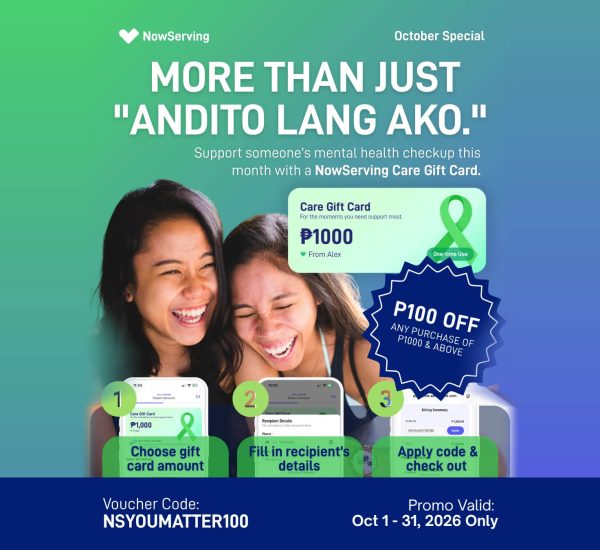
For friends who want to do more than listen but less than confront, the NowServing Care Gift Card was built for that in-between space. Send any amount as a gift card, which allows you to help your friend to begin their mental health treatment.
The recipient picks the doctor, the schedule, and the format, online or in person, with no pressure to perform a story they are not ready to tell. Your friend stays in charge, and not pressuring them to act instantly. The card also takes the most common wall off the table, which is the cost of mental health treatment. Weekly therapy in the Philippines runs PHP 1,500 to PHP 5,000 per session, a cost most students on a working-student schedule cannot absorb without trade-offs elsewhere.
A funded first session removes the breaking point that ends many treatment plans before they start, and knowing about cognitive behavioral therapy on NowServing gives a sense of what your friend might book.
How to Send a NowServing Care Gift Card
Sending a Care Gift Card is meant to feel like a quiet gesture, not a production. Follow these steps:
- Open the NowServing app on your phone.
- Tap on the NowServing Care Gift Cards section.
- Enter the recipient’s name, mobile number, or email (optional).
- Choose the amount you want to send.
- Add a short personal note if you want.
- Confirm and complete the payment.
Recipients receive the gift card immediately and can redeem it for online or in-person mental health support with any participating doctor on NowServing.
NOTE: NowServing Care Gift Cards are designed for flexibility, but can only be used one-time. Your friend can hold onto the card until they feel ready to book a session, with no expiry pressuring them into a faster decision than they want to make.

Frequently Asked Questions About Helping a Friend With Academic Burnout
What is academic burnout, and how is it different from regular stress?
Academic burnout is a prolonged state of emotional exhaustion, cynicism toward school work, and lower academic achievement, often measured using the academic burnout scale in recent studies. Regular academic stress usually lifts once the exam, project, or deadline passes. Burnout brings physical symptoms like sleep disruption and mental fatigue that ordinary stress rarely sustains over time.
How do I know when my friend needs professional help?
If the symptoms of burnout have lasted more than a few weeks and are affecting sleep, eating, or basic functioning, it is worth gently mentioning a school counselor or licensed therapist. The same applies when feelings of anxiety or loss of confidence do not lift on their own after the heavy academic season ends.
What if my friend insists they are fine?
Take the cue, and stay close anyway. Pushing for a confession or a treatment plan rarely helps; steady presence often does the heavier lifting over weeks. The NowServing Care Gift Card sits in their NowServing account until they decide otherwise, which removes the pressure that comes with a direct conversation and lets them choose the moment.
Can I send a NowServing Care Gift Card if I am also a student on a budget?
Yes. You can choose any amount that fits your budget, and even a partial session contribution is enough to start the conversation about care. Some friends pool money together to cover a fuller session, which works as a quiet group gesture without singling anyone out as the rescuer.
What types of sessions can the gift card be used for?
The NowServing Care Gift Card is only applicable for mental health doctor consultations. Recipients can use it to book a consultation with a psychotherapist, or start with a psychology consultation first. That way, you’ll know which treatment best suits your case.
What if I am worried my friend is more than burnt out?
If you sense something heavier than burnout, gently bring in a professional. The triggers to act on are complete withdrawal, signs of depression that have lasted weeks, or any mention of self-harm. You can also send the 24/7 help hotline for mental health in the Philippines, DOH-NCMH – 0917-899-8727.
Show Your Care Even in A Simple Way of Sending A Care Gift Card
Academic burnout is one of the quietest mental health issues young adults carry, partly because it hides behind the language of “I’m just tired.” Friends often see it first, and the cost to student success and well-being is real even when grades stay average for a while. The right gesture is rarely the loudest one, only the one that respects your friend’s pace and leaves the door open.
You do not have to choose between being a passive listener and a pushy fixer. Send a NowServing Care Gift Card today and show up for a friend in the simplest and private gesture.
This article is for general information only and is not a substitute for professional medical advice, diagnosis, or treatment. If symptoms are severe or getting worse, see a doctor or go to the nearest hospital.