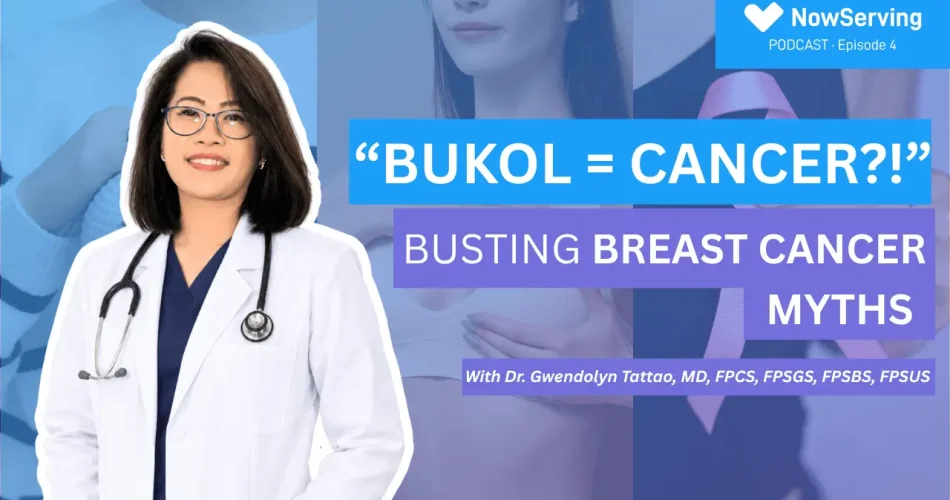
This fourth episode from The NowServing Podcast tackles the common myths about breast cancer. The host, ‘Yowni’ and guest oncologist – breast cancer expert, Dr. Gwendolyn Tattao, MD, MHM, MBA, FPCS, FPSGS, FPSBS, FPSUS are here to help us understand cancer of the breasts, and what to do when you suspect you have one.
Summary
Myth 1: Bata pa ako, hindi ako apektado ng breast cancer
Fact: Breast cancer can affect women in their 20s and 30s
Breast cancer is not a condition that only people in their 50s and up experience. Younger patients tend to have more aggressive and faster-growing cancer cells. That’s why, early awareness is a must to know your baseline or normal body condition.
If there’s a significant difference, this will prompt you to seek medical help. Thus, allowing oncologists – breast cancer specialists to verify whether or not you have breast cancer.
Myth 2: Wala naman breast cancer sa family namin, kaya hindi ako magkaka-cancer
Fact: 85% of cases have no family history
Despite not having breast cancer in the family’s medical history, experts found out that 85% of people still developed this type of cancer. At the same time, having a family history doesn’t automatically put you at risk.
“Most breast cancers are considered sporadic, meaning they occur in people even without a known inherited genetic cause.” – Dr. Gwendolyn Tattao, MD, MHM, MBA, FPCS, FPSGS, FPSBS, FPSUS
Aside from that, studies prove that females have a higher risk of developing breast cancer in their lifetime. Family history is just one factor, and there are other factors you need to consider to determine if you have breast cancer.
So, early assessment and screening is a must. Screening tests may include a mammogram and breast ultrasound.
Myth 3: Pag may na-feel akong bukol, sigurado cancer na yan
Fact: Most lumps are benign, but persistent lumps deserves a doctor check-up
A lump in the breast doesn’t automatically equate to a breast cancer lump. Most lumps are considered benign, like breast cysts, fibroadenomas, fibrocystic changes, etc. So, if you found a lump, it should prompt you to seek help to identify whether it is benign or malignant.
Doctors can immediately tell what the lump is once the result of your screening test is available.
- For younger patients – breast ultrasound
- For adult patients – mammogram
Myth 4: Self-exam lang enough na, di na kailangan magpa-doktor
Fact: Self-exam is the start and should not be used for diagnosis. Clinical screening tests are still a must (ultrasound and mammogram)
Self-examination is helpful so you know your normal health. It allows you to be aware of new lumps and detect changes, which you can know if you’ve done a self exam before. However, that is not enough as it cannot detect small breast cysts. Screening imaging like breast ultrasound and mammogram can do that.
In short, a self-exam is helpful, but you shouldn’t miss the clinical breast exams by a doctor.
Myth 5: Trauma or injury to the breast will cause cancer
Fact: There’s no medical evidence that proves a trauma can cause breast cancer
This is a common misconception from people where a trauma can lead to lumps. Reality is, there’s no medical evidence of trauma as a cause of breast cancer. Although, trauma can cause swelling, bruising, and fat necrosis (benign lumps). Still, those are not equivalent to malignant cancer cells in the breast area.
If there’s a noticeable change, and you suspect it is breast cancer, visiting a doctor is the best option. That way, your fear of developing the disease can be verified by a specialist immediately.
Myth 6: Hindi nagkakaroon ng breast cancer ang mga lalaki
Fact: All genders can develop breast cancer, especially if they have high-risk factors
Although it is rare, males can also develop breast cancer. Since they have breast hormones and tissues, it is not impossible for them to get breast cancer.
Males are at a higher risk if they have the following:
- genetic mutations
- hormonal condition
- undergoing medical treatments
- older age
If you notice changes in the nipple area and other parts of the breast, that should compel you to visit a doctor for a medical screening.
How to Properly Do A Self-Examination
If you’re planning to do a self-exam during your menstrual period, it’s best to do it during the mid-cycle. This is the time where the breast is least tender and lumpy.
Besides that, if you have irregular periods or have hormonal problems, the best option is to do it consistently every month. In short, just select 1 date per month for your annual breast self-exam to be familiar with your normal breast’s look and shape. Thus, allowing you to easily notice changes.
- Visual Inspection – Checking if there are swelling, redness, dimpling, eczematization of the nipples & areola.
- Palpation or Manual Inspection – Using the pads of your 3 fingers, you check for lumps with a circular or up and down motion.
Read this related article to understand more about lump in breast and self-examination.
Listen to the podcast on Spotify, Apple Podcasts, and YouTube
Resources Mentioned
- Oncologist – Breast Cancer doctor mentioned in the story – Book a doctor consultation with Dr. Gwendolyn Tattao, MD, MHM, MBA, FPCS, FPSGS, FPSBS, FPSUS
- NowServing App for Online and In-person doctor consultation – Download the app to your device!
- Mammogram screening test – Schedule an appointment on NowServing
Final Takeaway
Everyone can develop lumps in their breasts, but that doesn’t automatically mean that they have breast cancer. These lumps are mostly benign, while others can be malignant. That’s why being aware of these lumps matter, and what you do next becomes your most crucial decision.
Determine whether or not you have a benign or malignant lump in your breast through a clinical assessment. Book a consultation with an oncologist – breast cancer doctor on NowServing!