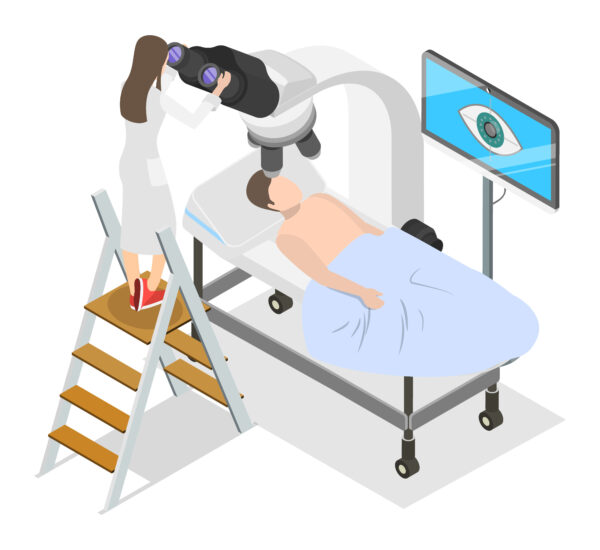
As you grow older, you can develop refractive errors, like nearsightedness, farsightedness, and astigmatism that can affect your vision. It can lead to blurry vision, which can greatly impact your day-to-day activities. Fortunately, there’s a permanent fix for these conditions. Discover LASIK eye surgery for nearsightedness, farsightedness, and astigmatism as the suitable eye . Explore why you’re a good candidate for LASIK, and why making this decision important for your eye health.
Understanding Refractive Errors: What’s Affecting Your Vision?
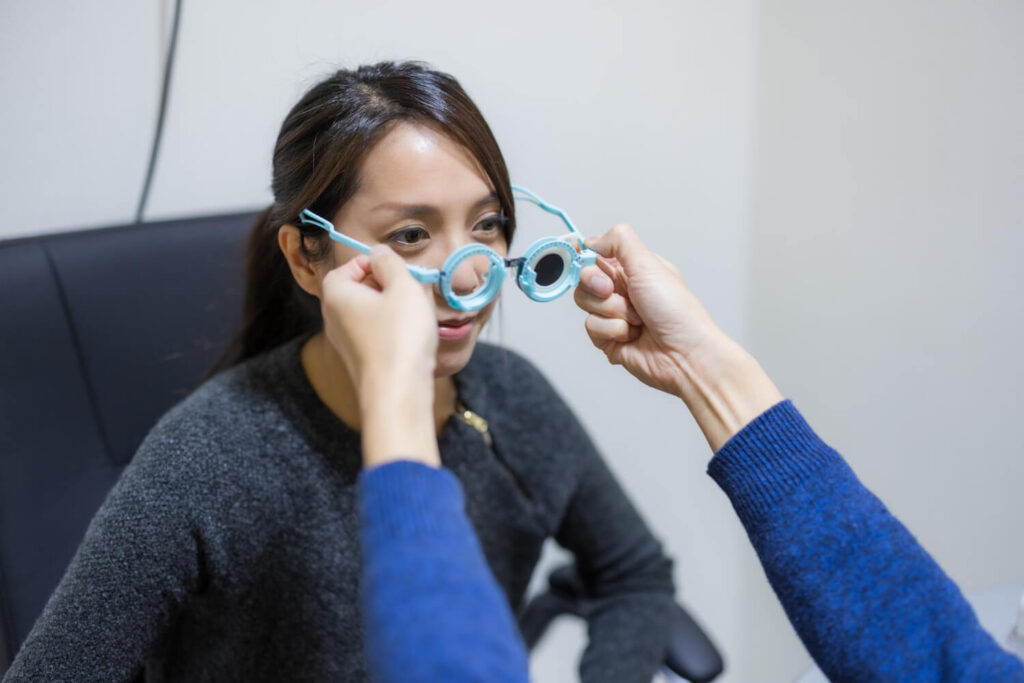
Refractive errors occur when the shape of your eye doesn’t bend light correctly, causing blurry vision. Think of your eye like a camera—when everything is perfectly aligned, you get a sharp, clear picture. But when something is slightly off, the image becomes fuzzy. Let’s discuss the common refractive errors below!
What Is Nearsightedness (Myopia)?
Nearsightedness, or myopia, means you can see nearby objects clearly, but distant objects appear blurry. This happens when your eyeball is too long or your cornea is too curved, causing light to focus in front of the retina instead of directly on it. You might notice yourself squinting to read street signs, struggling to see the board in school, or sitting closer to the TV.
Take note that it can worsen over time, which is why getting checked by an eye specialist is a must. Its worst form is high myopia, which is severe nearsightedness. It can significantly impact your quality of life and requires careful evaluation, especially if you want to try LASIK to fix it.
What Is Farsightedness (Hyperopia)?
Farsightedness works the opposite way. People with hyperopia can often see distant objects more clearly than nearby ones, though in some cases, both near and far vision can be affected. While many children are born slightly farsighted and outgrow it, some adults continue to struggle with this condition.
This vision problem occurs when the eyeball is too short or the cornea is too flat, causing light to focus behind the retina. Common signs that you have hyperopia are you experience eye strain when reading, have trouble focusing on close-up work, or get headaches after tasks that require near vision.
What Is Astigmatism?
Astigmatism is a bit different than the 2. Instead of the cornea being perfectly round like a basketball, it’s shaped more like a football curved more in one direction than the other. This irregular shape causes light to focus on multiple points, creating blurred or distorted vision at all distances. You might notice that straight lines appear wavy, lights seem to have halos around them, or you experience frequent eye strain and headaches. Most people with astigmatism also have some degree of nearsightedness or farsightedness.
How Does Laser Eye Surgery Work?
LASIK, which stands for Laser-Assisted In Situ Keratomileusis, is a type of refractive surgery that reshapes your cornea to correct how light enters your eye. The procedure uses advanced laser technology to precisely remove microscopic amounts of corneal tissue, allowing light to focus correctly on your retina.
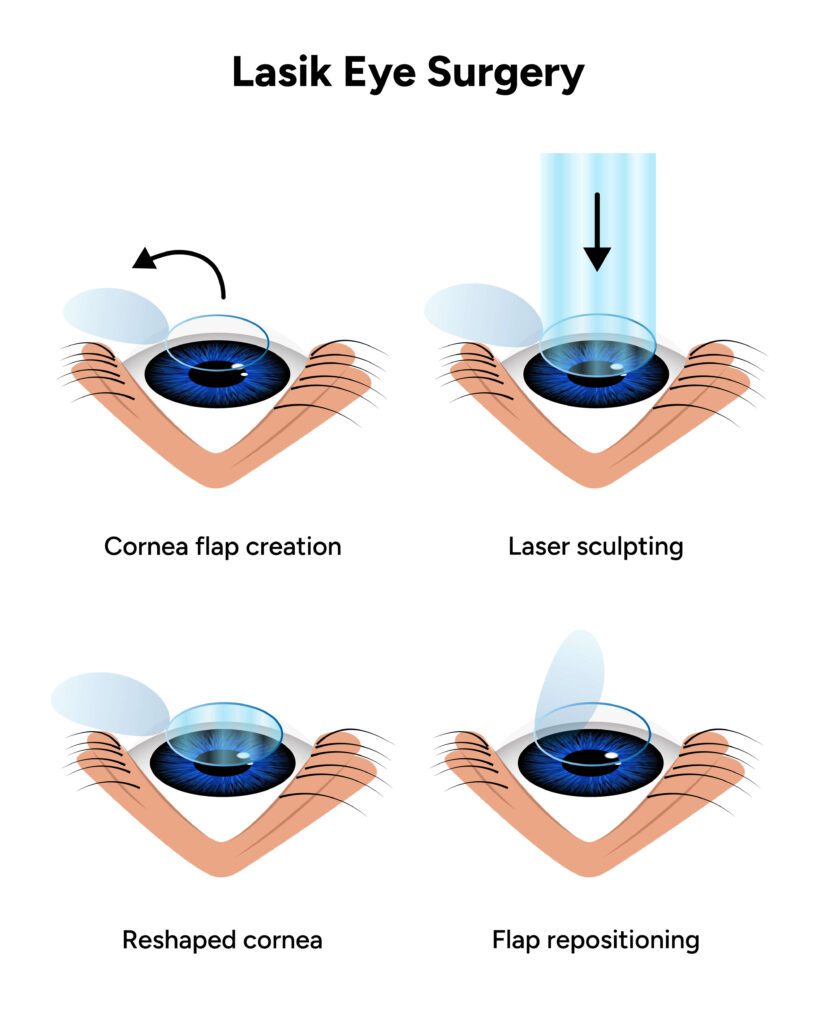
This simple, yet fast procedure involves the following:
- creating of the corneal flap
- reshaping the cornea with laser
- repositioning the flap
The entire process typically takes less than 30 minutes for both eyes, and most people notice improved vision almost immediately.
Read this related article to have an in depth knowledge about the LASIK eye surgery procedure.
Different LASIK Approaches for Different Vision Problems
As mentioned, this vision correction surgery is the best option for fixing the most common refractive errors as it focuses on fixing the cornea. The shape of the cornea is the main reason why people have blurry visions. and LASIK can help resolve that. Although, despite the same use of medical treatment, eye surgeons will apply different approaches to fix astigmatism, myopia, and hyperopia.
That’s why it’s best to seek doctor consultation first to better understand your case. Some refractive errors can be challenging than the other, which results in more corneal tissue being removed. It’s most likely the case if you have a severe form of myopia and hyperopia.
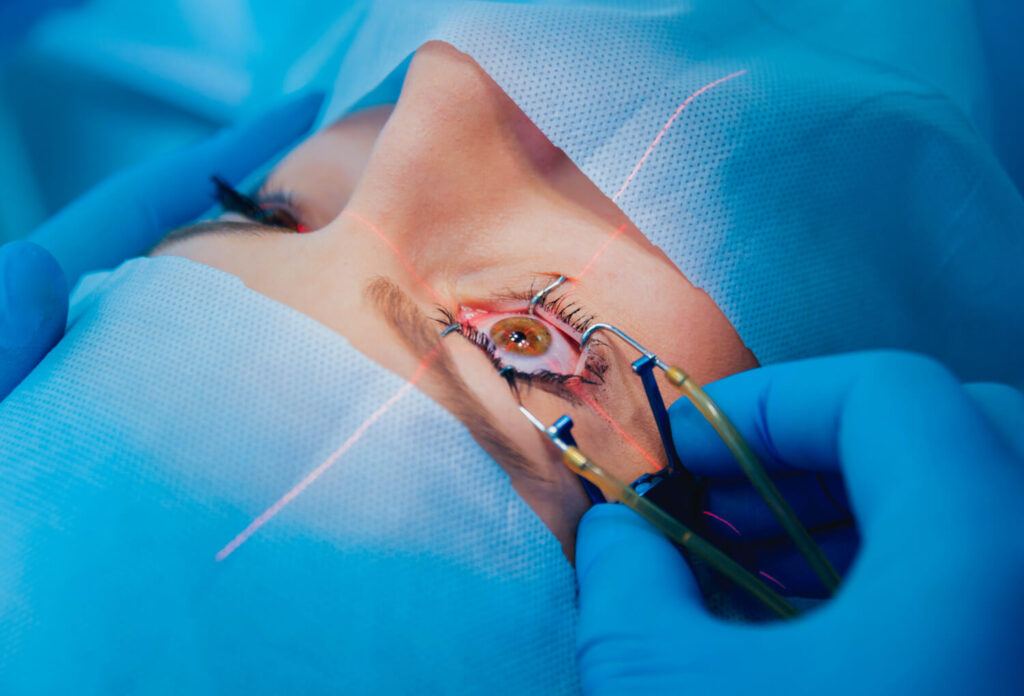
LASIK Laser Eye Surgery for Nearsightedness (Myopia)
For nearsightedness, the laser removes tissue from the center of the cornea, making it flatter. This adjustment allows light rays to focus further back, landing precisely on the retina instead of in front of it. The more severe your myopia, the more corneal tissue needs to be removed.
Laser eye surgery for myopia is the most common type of LASIK performed. Success rates are high, and most patients achieve 20/20 vision or better. Recovery time is generally quick, with many people returning to normal activities within a few days.
LASIK Laser Eye Surgery for Farsightedness (Hyperopia)
Meanwhile, LASIK eye surgery for farsightedness works differently. Instead of flattening the cornea, the laser removes tissue from the outer edges, making the cornea steeper in the center. This farsightedness treatment brings the focal point forward onto the retina.
The results tend to be most stable for mild to moderate hyperopia, while some patients with higher levels of farsightedness might need an enhancement procedure later.
LASIK Laser Eye Surgery for Astigmatism
Astigmatism correction through LASIK requires the most customized approach. The laser must reshape the cornea differently in various meridians to create a more uniform, spherical surface. Modern wavefront-guided LASIK technology maps your eye’s unique irregularities and creates a personalized treatment plan.
LASIK surgery can effectively correct refractive errors when astigmatism is combined with nearsightedness or farsightedness. Don’t worry as during the eye consultation phase, the doctor will explain if your astigmatism is within the treatable range. Thus, allowing you to pursue LASIK procedure.
What Eye Conditions LASIK Can’t Fix?
Despite being a remarkable medical treatment, LASIK can still have limitations as it cannot fix all eye conditions. It can only fix mild to moderate forms of myopia, hyperopia, and astigmatism. At the same time, if you have a combination of these refractive errors, you are suitable for LASIK.
Here’s what LASIK can’t fix:
- Presbyopia: This age-related condition affects your ability to focus on close objects, typically starting around age 40. While LASIK can correct your distance vision, you’ll likely still need reading glasses as you get older. Some surgeons offer “monovision” LASIK, where one eye is corrected for distance and the other for near vision, but this doesn’t work for everyone.
- Cataracts: LASIK doesn’t treat or prevent cataracts, which is the clouding of your eye’s natural lens. If you have cataract symptoms, you’ll need a different surgical procedure to replace the clouded lens.
- Glaucoma, Macular Degeneration, or Retinal Problems: These medical conditions affect different parts of the eye and require their own specific treatments. LASIK only reshapes the cornea and won’t address these more serious eye health issues.
- Keratoconus: This progressive condition causes the cornea to thin and bulge outward. LASIK is actually contraindicated for keratoconus patients, as it can worsen the condition.
- Severe Dry Eye: While mild dry eye can often be managed, severe chronic dry eye may make you a poor candidate for LASIK, as the procedure can temporarily worsen dryness.

Who Makes a Good Candidate for LASIK Surgery?
Not everyone with refractive errors is a suitable candidate for laser eye surgery. Your ophthalmologist will evaluate several factors to determine if LASIK (refractive surgery) is right for you.
Good candidates typically:
- Are at least 18 years old (preferably 21 or older)
- Have had a stable prescription for at least one year
- Have healthy corneas with adequate thickness
- Don’t have autoimmune diseases or conditions that affect healing
- Aren’t pregnant or nursing (hormones can affect vision stability)
- Have realistic expectations about the outcomes
Your overall eye health plays a crucial role in determining candidacy. During your consultation, your doctor will perform comprehensive tests, including corneal topography, pupil size measurements, and tear film evaluation. These tests help create a complete picture of your eye health and determine the safest treatment approach.
How to Book Laser Eye Surgery for Myopia, Hyperopia, and Astigmatism on NowServing
NowServing is a leading healthcare platform that helps people connect and communicate with all the licensed doctors in the Philippines. No matter where you are, you can undergo a doctor consultation. However, you can also use NowServing to book an eye consultation for LASIK. Here’s how!
- Open the NowServing app or access this link to view the LASIK doctors in the Philippines
- Once you’ve chosen your doctor, tap “Book Appointment” to start the booking process
- Fill-up the form provided
- Finish the booking process and wait for the doctor to accept your appointment.
Remember that LASIK can be expensive, so you can also utilize NowServing to compare doctor rates and their credentials. Thus, helping you to find the best LASIK doctor for your case.
Read this related article to know more about the cost of LASIK in the Philippines.
Frequently Asked Questions About LASIK Eye Surgery for Nearsightedness
Is LASIK the best nearsightedness treatment or are there other alternatives?
Yes, it is the best laser treatment to fix myopia. LASIK focuses on reshaping the cornea, which is the main cause of nearsightedness. By fixing the shape, it allows the light to enter correctly, allowing you to see better.
At what age should I get LASIK for nearsightedness, farsightedness, and astigmatism?
Patients at the age of at least 18 to 40 years old are viable to get LASIK. However, special cases can prohibit you from getting LASIK. It’s best to consult your eye doctor immediately to discuss if you are a good candidate for LASIK.
You can’t heal properly if you have chronic conditions like:
- HIV
- Diabetes
- Autoimmune Disease
How long do LASIK results last?
For most people, LASIK provides permanent correction of nearsightedness, farsightedness, and astigmatism. However, your eyes can still change over time due to aging. Some patients may experience minor regression, especially with higher prescriptions. Additionally, presbyopia (age-related near vision loss) will still occur as you get older, potentially requiring reading glasses.
What are the risks and side effects of laser eye surgery?
Like any surgical procedure, LASIK carries some risks, though serious complications are rare with experienced surgeons. Common temporary side effects include dry eyes, glare, halos around lights, and light sensitivity. These typically improve within a few months. Serious complications like infection or vision loss are extremely rare. Choosing a qualified, experienced ophthalmologist significantly reduces your risk.
Conclusion
LASIK eye surgery for nearsightedness, farsightedness, and astigmatism is a proven and tested medical procedure that works against mentioned refractive errors. It is a precise procedure that offers clearer vision, which liberates you from use of glasses and contacts. With this advanced laser technology, you can permanently fix your eyesight.
Whether you struggle with seeing distant objects due to myopia, experience eye strain from hyperopia, or deal with distorted vision from astigmatism, laser eye surgery might offer the solution you’ve been looking for. Book a LASIK doctor today on NowServing!
Test Your Knowledge: LASIK for Nearsightedness, Farsightedness, and Astigmatism
Take this short quiz to see how much you learned about LASIK eye surgery and find out if it might be right for you.